Sweden’s Krona Problem Is Making the Euro Harder to Ignore
Years of currency weakness have shown Swedish households how quickly purchasing power can erode. For investors, the question is no longer only what to own — but increasingly which currency to own it in.
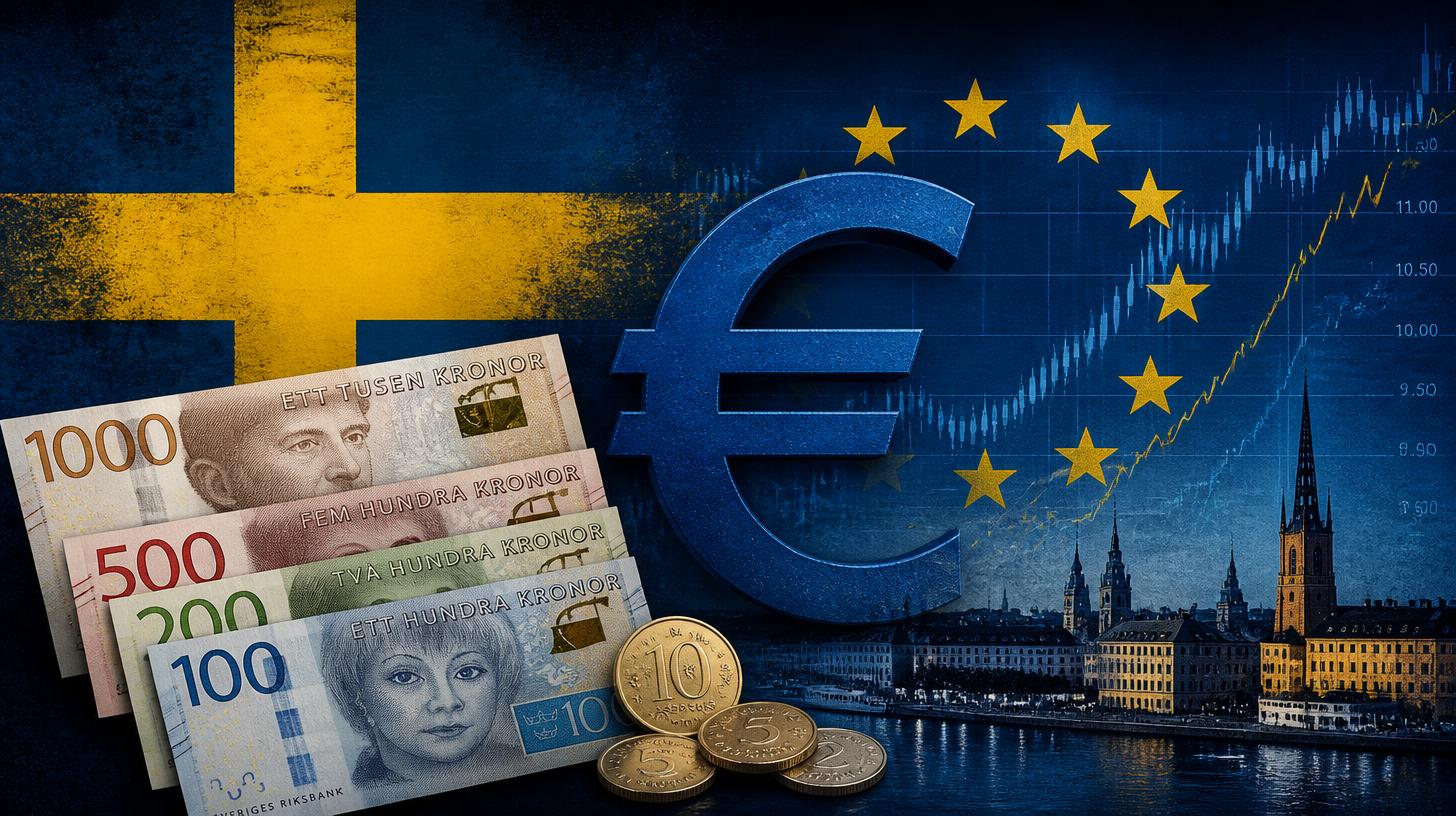
For Swedish investors, the value of an investment is usually measured in kronor. But that can hide another risk.
Even when a portfolio rises in SEK terms, the currency itself can lose purchasing power against the euro, the dollar and other major currencies.
Sweden has already seen what that can mean. The krona weakened sharply during 2022 and 2023, contributing to higher prices for Swedish households and helping erode real purchasing power, according to Riksbank Governor Erik Thedéen.
That experience has pushed currency exposure higher on the list of issues Swedish investors need to consider.
Should part of a Swedish portfolio also be held in euros?
A weak krona reaches far beyond the currency market
Currency movements can sound abstract. For households, they are anything but. Sweden is a relatively small, open economy that imports a large amount of goods and services from abroad.
When the krona weakens against the euro, European products become more expensive in SEK terms. The effect can eventually reach everything from food and electronics to cars, machinery, holidays and energy-related costs.
Businesses importing goods face higher costs. Some of those costs are passed on to customers. And Swedish households effectively discover that the same salary buys less abroad than it did before.
The Riksbank has repeatedly highlighted this relationship. Thedéen has warned that a weaker krona can generate unwanted inflationary pressure, while the sharp depreciation during the high-inflation period contributed to a greater loss of purchasing power in Sweden than in many comparable economies.
For investors, that creates a second layer of risk. It is possible to protect capital from a falling stock market and still lose international purchasing power through the currency.
SEK concentration is a risk many investors barely notice
Consider a Swedish investor who receives a salary in SEK. Their bank account is in SEK. Their home is in Sweden. Their pension is largely connected to the Swedish economy. And a large part of their investments may also be denominated in kronor.
That investor is not only exposed to individual companies or markets. They are heavily exposed to one currency and one economy.
Normally, that may not feel dangerous. But when the krona falls sharply, the concentration becomes visible. A €50,000 expense abroad becomes more expensive. European property becomes more expensive. Imported products become more expensive. Foreign investments require more kronor to purchase.
A portfolio therefore does not need to lose nominal value for its owner to become poorer internationally. Currency diversification is one way investors attempt to reduce that dependence.
Why the euro is the obvious alternative for many Swedes
Sweden may not use the euro, but much of its economic life is connected to the euro area. Germany, Finland, the Netherlands, France and other European economies form part of Sweden’s largest trading environment.
Swedish companies buy and sell across the continent. Households travel throughout the eurozone. Investors buy European equities. Businesses invoice customers in euros.
That makes EUR exposure different from making a speculative bet on an exotic foreign currency. For many Swedish investors, the euro represents exposure to an economic area they already interact with constantly.
Holding part of a portfolio in euro-denominated assets can therefore serve several purposes. It can diversify currency exposure. It can provide capital for future euro-denominated expenses. It can reduce complete dependence on the krona. And if SEK weakens against EUR, the value of euro-denominated holdings rises when translated back into kronor.
But that protection works in both directions. If the krona strengthens, the same euro holdings can fall in SEK terms.
Why a lasting krona recovery looks unlikely
This is where the argument becomes uncomfortable. Nothing in the past two decades suggests the krona is about to reverse its long decline, and little in Sweden’s structural position points to a durable recovery over the next twenty years.
The weakness has not been a single bad year. It has been a slow, repeated pattern: a small, open, export-driven economy with its own currency, a highly indebted household sector that limits how far interest rates can be pushed, and a currency that global investors treat as a risk asset to be sold whenever sentiment turns.
Short-lived rebounds do happen. The krona regained some ground against the euro and the dollar over the past year. But recoveries of that size have appeared before and faded again, and they have never restored the purchasing power lost over the previous decades.
That is the point. For a Swedish saver planning over ten or twenty years, the realistic assumption is not a strong krona, but continued exposure to a currency that has structurally lost value against the euro.
The question then becomes uncomfortably simple: does an investor really want 100% of their financial life dependent on that one currency?
Asked about the current situation for the krona, Fredrik Nilsson, Senior Account Manager at Handelsportalen, is blunt. He recommends that Swedish savers hold around half of their money in euros — either in euro-denominated investments or in a euro interest-bearing account — simply to stop losing more purchasing power.
“My advice to Swedish citizens is straightforward: put about half of your money in euros. If you do not want market risk, put it in a euro interest account. At least then you stop losing more,” Nilsson says.
His reasoning is not a market forecast but damage control. A saver who keeps everything in kronor is, in his view, making a concentrated currency bet without realising it — and the past two decades show which way that bet has gone.
Diversification is not the same as abandoning the krona
An investor does not have to choose between “all SEK” and “all EUR.” That is rarely how professional portfolio construction works.
Instead, investors can spread exposure. Part of a portfolio may remain in Swedish equities and SEK-denominated investments. Another part could contain European companies or funds with euro exposure. Global investments can introduce dollars and other currencies. Cash reserves can also be divided depending on future financial needs.
The goal is not necessarily to find the currency that will rise the most next month. It is to avoid a situation where one currency determines the outcome of nearly everything an investor owns.
Currency can change the real return on an investment
Imagine a Swedish investor buys a European asset worth €100,000. If that investment does absolutely nothing for a year but the euro strengthens 10% against the krona, its value measured in SEK rises by roughly the same amount — purely because of the currency movement.
The reverse is equally important. If SEK strengthens 10%, the Swedish value of that euro investment declines, even if the underlying asset has not moved.
Currency can therefore amplify returns. Or destroy part of them. That is why sophisticated investors often separate two questions.
Is this a good investment? And do I want exposure to the currency in which that investment is priced?
They are not always the same decision.
Private finances can also benefit from matching currencies
Investing is only part of the equation. There are situations where holding euros can have a practical financial purpose.
Someone planning to buy property in Spain may eventually have a large EUR liability. Someone regularly spending time in the eurozone has recurring euro expenses. A business owner purchasing goods from European suppliers may also have euro exposure.
Keeping every asset in SEK while knowing a major future expense will be in EUR creates currency risk. If the krona falls before the purchase, the expense becomes more expensive. Holding some euros beforehand can reduce that uncertainty. It is the same principle companies use when managing foreign-exchange exposure.
The biggest mistake may be treating currency as an afterthought
Swedish investors spend enormous amounts of time comparing funds, stocks and interest rates. Far fewer ask what happens to their wealth if SEK moves 10% against another major currency.
But recent history has demonstrated that the effect can be significant. The krona’s earlier depreciation contributed to inflation and reduced household purchasing power. Its subsequent strengthening has helped move in the opposite direction.
Currency exposure deserves to be treated as part of portfolio construction rather than something investors notice only when booking a holiday abroad.
What investors can consider
There is no universal percentage of a portfolio that should be held in euros. The correct allocation depends on income, expenses, investment horizon, risk tolerance and future financial commitments.
- How much of my wealth is currently tied to Sweden?
- What would happen to my purchasing power if SEK weakened significantly?
- Do I expect major expenses in euros?
- Do my existing funds already give me foreign-currency exposure?
- Would EUR diversification reduce risk — or simply introduce a new currency bet?
- Am I investing because of a long-term strategy or merely reacting to yesterday’s exchange rate?
That final question matters. Buying a currency after a major move can be just as dangerous as chasing a stock after a rally.
Sweden’s currency debate is really a diversification debate
The krona is not disappearing. And a weaker period for SEK does not mean investors should rush to abandon Swedish assets. Sweden remains a wealthy, sophisticated economy, and the Riksbank itself has argued that the krona has the potential to strengthen over time.
But the experience of recent years has exposed something many households previously ignored. Currency is a risk. And concentrating almost everything in one currency is still concentration — even when that currency is the one you use every day.
For Swedish investors, the euro therefore does not have to be viewed as a replacement for the krona. It can be viewed as a second layer: a hedge against purchasing-power risk, a way to diversify capital and, for investors already exposed to European markets, a currency that may already play a much larger role in their financial lives than they realize.
The goal is not to predict whether the krona or the euro wins next year. The goal is making sure your entire financial future doesn’t depend on guessing correctly.
Want to understand how SEK/EUR movements can affect your portfolio?
Handelsportalen, at handelsportalen.com, publishes a more detailed guide to this subject. It explains, step by step, how currency exposure is measured inside a portfolio, how euro-denominated assets behave when the krona moves, and which practical options are open to Swedish investors — from European equities and funds to euro cash reserves held for future expenses.
The platform also covers how to size an allocation sensibly, the costs and tax questions that come with holding assets in another currency, and the most common mistakes investors make when they react to an exchange rate instead of following a plan. Readers can work through the material at their own pace and use it as a checklist before making any changes to their own portfolio.